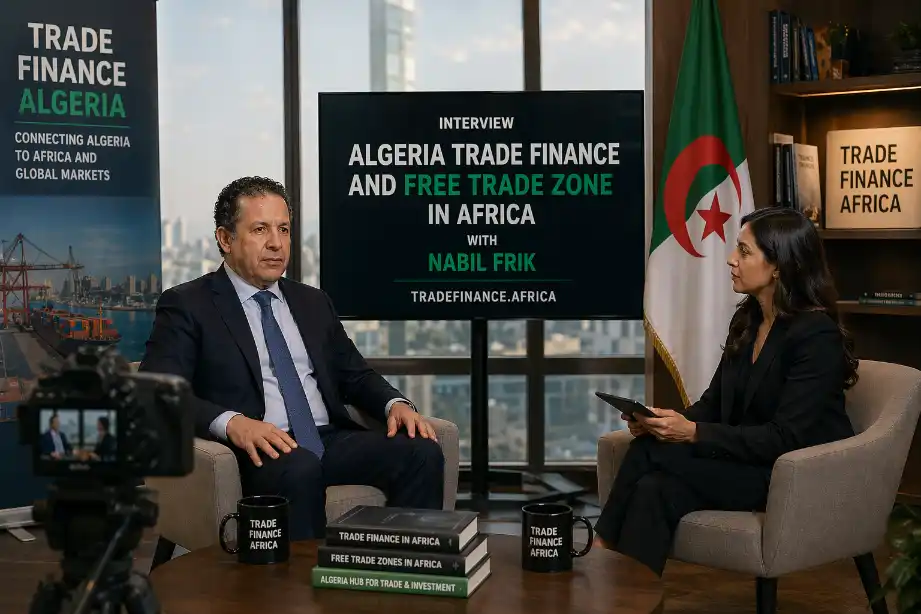
NABIL FRIK INTERVIEW ABOUT ALGERIA’S TRADE FINANCE FOR AFRICA
Nabil Frik is an distinguished C-Suite banker and an authoritative expert on the Algerian financial landscape, boasting over 25 years of leadership across international banking. Nabil Frik who is a native Arabic and French speaker, he possesses a unique cultural and professional bridge between European capital markets and the MENA-Africa corridor
With a career spanning three continents, including senior roles at British Arab Commercial Bank (BACB), Qatar National Bank (QNB), Siemens Financial Services, ING Barings and Lahmeyer International. he has managed investment and trade portfolios
Notably, he has led marketing and origination teams specifically focused on Algiers and Abidjan, making him a preeminent voice on integrating Algeria’s corporate banking sector into the broader African trade ecosystem
Interview: Algeria’s Corporate Strategy for the African Continental Free Trade Area (AfCFTA)
ALGERIA TRADE FINANCE MAGAZINE: Mr. Frik, as a specialist in the region, how would you define the strategic importance of the AfCFTA for Algerian corporates?
Nabil Frik: The AfCFTA represents a historic shift for Algerian corporates, offering them duty-free access to a market of 1.3 billion people. For years, Algerian business has been focused inward or toward the Mediterranean; this agreement provides the structural framework to pivot south, allowing our national champions in electronics, agri-food, and construction to scale across the continent.
ALGERIA TRADE FINANCE MAGAZINE: What is the primary Trade Finance objective for an Algerian company looking to export to West Africa for the first time?
Nabil Frik: The objective is risk mitigation and liquidity management. A corporate must ensure it has access to robust Trade Finance instruments—such as Letters of Credit or Bank Guarantees—that are accepted by Sub-Saharan counterparts. This ensures that the Algerian exporter is paid on time while providing the African buyer with the necessary credit terms to finalize the purchase.
ALGERIA TRADE FINANCE MAGAZINE: How does the Transaction Banking infrastructure in Algeria need to evolve to support these new trade flows?
Nabil Frik: Speed is the new currency. To support the AfCFTA, Algerian transaction banking must move toward real-time settlement and digital document processing. Corporates need the ability to manage their cash and payments across diverse African currencies and jurisdictions without the friction of traditional, paper-based systems.
ALGERIA TRADE FINANCE MAGAZINE: You’ve worked extensively with Financial Institutions; how can Algerian banks better serve corporates in the AfCFTA context?
Nabil Frik: Algerian banks must expand their FI Coverage by building direct relationships with regional African banks. Instead of routing everything through European hubs, direct correspondent banking lines between Algiers and hubs like Lagos, Nairobi, or Abidjan will significantly reduce transaction costs and delays for Algerian exporters.
ALGERIA TRADE FINANCE MAGAZINE: What role do you see for ECA-backed Export Finance in helping Algerian firms win large African infrastructure contracts?
Nabil Frik: It is a decisive tool. Export Credit Agency (ECA) support allows Algerian corporates to offer long-term, low-interest financing to their African clients. This is how you win large-scale projects in energy or transport—by providing not just the technical expertise, but also a competitive, de-risked financing package for the buyer.
ALGERIA TRADE FINANCE MAGAZINE: How should Algerian corporates approach Credit Risk when entering less familiar African markets?
Nabil Frik: They should leverage Structured Trade Finance. By using credit insurance and multilateral guarantees, corporates can protect their balance sheets against non-payment. It’s about being bold in market entry but disciplined in financial execution, utilizing deep market intelligence to assess the creditworthiness of their new partners.
ALGERIA TRADE FINANCE MAGAZINE: Will the AfCFTA encourage more Syndicated Lending among Algerian and other African banks?
Nabil Frik: Definitely. Large-scale intra-African trade deals often exceed the risk appetite of a single bank. We will see more syndicates where Algerian banks partner with pan-African institutions to share the risk and provide the massive liquidity required for industrial-scale exports and cross-border investments.
ALGERIA TRADE FINANCE MAGAZINE: How important is the Francophone Africa corridor for Algerian businesses under this new trade agreement?
Nabil Frik: It is a natural starting point. The shared language and similar legal frameworks make it easier for Algerian firms to navigate the regulatory landscape. Leveraging this cultural and linguistic proximity allows for faster Business Development and more stable institutional partnerships.
ALGERIA TRADE FINANCE MAGAZINE: What impact will Digital Transformation have on the actual movement of goods from Algeria to the rest of the continent?
Nabil Frik: Digital innovation will eliminate the hidden costs of trade. From e-certificates of origin to digital Bills of Lading, moving toward a paperless environment will accelerate customs clearance at borders, which is currently one of the biggest bottlenecks for intra-African trade.
ALGERIA TRADE FINANCE MAGAZINE: How does Commodity Finance need to adapt as Algeria seeks to export more processed goods rather than raw materials?
Nabil Frik: It must become more sophisticated. We need to move toward Value-Chain Finance, where the bank supports the corporate from the raw material stage through to the finished product and eventual export. This requires a deeper understanding of the corporate’s production cycle and the specific risks associated with manufacturing.
ALGERIA TRADE FINANCE MAGAZINE: Is ESG (Environmental, Social, and Governance) reporting now a requirement for Algerian trade with Africa?
Nabil Frik: It is becoming one. Global investors and African development banks increasingly require ESG compliance to release funding. Algerian corporates that embed these frameworks early will find it much easier to attract the capital and insurance needed to fuel their African expansion.
ALGERIA TRADE FINANCE MAGAZINE: What can Algerian corporates learn from the GCC model of trade hubs?
Nabil Frik: The importance of Logistics and Finance Integration. The GCC succeeded by creating world-class ports and free zones that are directly linked to powerful trade finance banks. Algeria can mirror this by developing integrated Trade Hubs along the Trans-Saharan corridor, where logistics and finance work in perfect sync.
ALGERIA TRADE FINANCE MAGAZINE: How can Project Finance help Algerian companies invest in production facilities within other AfCFTA countries?
Nabil Frik: Project Finance allows for off-balance-sheet funding, where the project’s future cash flows serve as collateral. This is ideal for Algerian corporates looking to set up manufacturing plants in West or East Africa, as it limits the parent company’s direct risk while facilitating local industrialization.
ALGERIA TRADE FINANCE MAGAZINE: You’ve conducted feasibility studies for multilaterals; how should Algerian firms use agencies like the AfDB?
Nabil Frik: They should view them as partners for De-risking. Multilateral agencies offer various guarantee products that can protect an Algerian investment against political or currency risks. Coordination with these bodies is essential for any corporate looking at long-term, capital-intensive African ventures.
ALGERIA TRADE FINANCE MAGAZINE: Finally, looking toward 2030, what is your vision for Algeria’s corporate banking sector in Africa?
Nabil Frik: My vision is a fully integrated North-South Financial Bridge. By 2030, Algerian corporates should be as comfortable operating in Sub-Saharan Africa as they are at home , supported by a banking sector that provides seamless digital trade finance, robust risk protection, and the strategic capital needed to make Algeria a dominant economic force on the continent.