


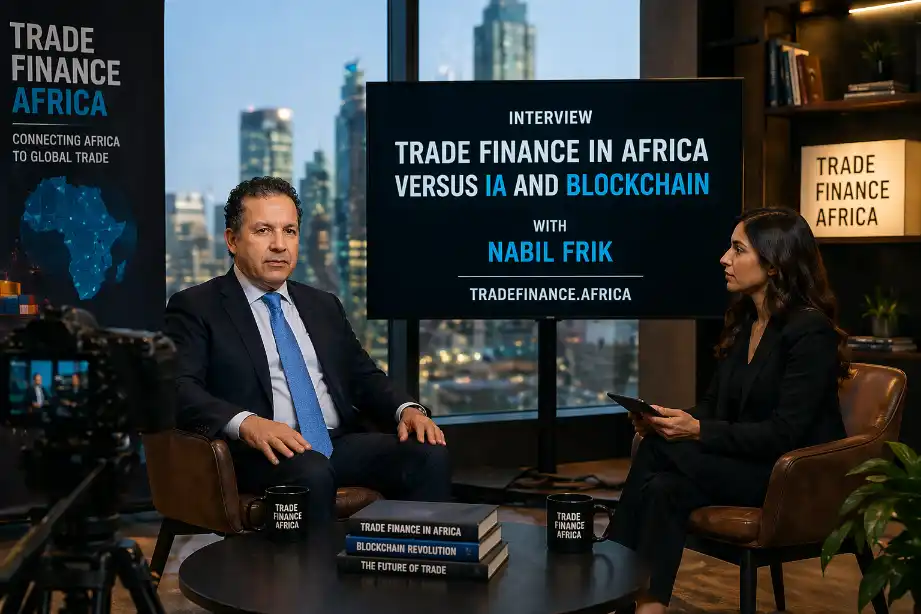
INTERVIEW WITH NABIL FRIK ABOUT AI VERSUS TRADE FINANCE IN AFRICA
Nabil Frik is an accomplished C-Suite banker and Managing Director with over 25 years of leadership experience in international financial institutions across Europe, the Middle East, Africa, and Asia
A dual British-German national fluent in four languages, Mr. Frik has a proven track record of managing portfolios and scaling businesses in Transaction Banking, Trade Finance, and Export & Project Finance. Most recently, as Managing Director at British Arab Commercial Bank (BACB), he oversaw strategic accountability for Financial Institutions and Trade Finance across EMEA and Asia.
Beyond traditional banking, he is an entrepreneur in the digital and fintech space, making him a leading voice on the intersection of emerging market finance and technological innovation
Interview: Trade Finance in Africa — The Digital Frontier
AFRICA BUSINESS: Mr. Frik, you have led banking operations across three continents. How would you characterize the current state of Trade Finance in Africa today?
Nabil Frik: Africa’s trade finance landscape is at a pivotal crossroads. While we see a massive financing gap, my experience managing billion-dollar portfolios across the EMEA region has shown me that the appetite for growth is immense. We are moving away from purely traditional, paper-heavy processes toward a model that demands more revenue diversification and geographic reach, particularly in underserved markets like Sub-Saharan and Francophone Africa.
AFRICA BUSINESS: There is much talk about Blockchain. How can this technology practically address the Trade Finance Gap in Africa?
Nabil Frik: The gap is often a result of friction—slow document verification and lack of transparency. Blockchain serves as a decentralized ledger that can provide a single source of truth for all parties in a transaction. In my time structuring complex cross-border deals, the most significant delays were always document-related; Blockchain can digitize these Trade Finance and GTB workflows, reducing the time from weeks to hours.
AFRICA BUSINESS: You are also the founder of a Fintech company. How is Artificial Intelligence (AI) specifically changing risk management for African banks?
Nabil Frik: AI is a game-changer for KYC, AML, and Compliance Frameworks, especially in high-risk jurisdictions. At BACB, I led remediation programs where we had to manage complex regulatory expectations. AI can now analyze vast amounts of data to detect patterns of fraud or money laundering far more accurately than manual reviews, which protects the bank’s correspondent banking network while allowing more legitimate trade to flow.
AFRICA BUSINESS: Can AI help small and medium-sized enterprises (SMEs) in Africa, who often struggle to get credit?
Nabil Frik: Absolutely. Traditional credit policies often rely on collateral that SMEs don’t have. AI-driven Credit Policy models can look at alternative data—cash flow patterns, mobile money transactions, and even social proofs—to assess creditworthiness. This allows us to scale Transaction Banking and Commodity Finance to a level of the market that was previously considered too risky.
AFRICA BUSINESS: Regarding Blockchain, what are the hurdles to widespread adoption among African Financial Institutions (FIs)?
Nabil Frik: The hurdle isn’t the technology; it’s the Leadership and Governance and the need for standardized regulatory frameworks. During my board deliberations, I’ve seen that capital allocation for digital strategy is often weighed against immediate P&L needs. For Blockchain to work, we need a MENA–Europe and Sub-Saharan corridor where all banks agree on the same digital protocols.
AFRICA BUSINESS: How does AI improve the accuracy of commodity trade finance, a sector where you’ve secured marquee mandates?
Nabil Frik: In Commodity Finance, price volatility and collateral monitoring are constant challenges. AI algorithms can provide real-time predictive analytics on global commodity prices and automate the tracking of physical goods via satellite imagery or IoT sensors. This level of Risk Management ensures that fee income and balance sheet utilization are optimized based on current market realities rather than historical lag.
AFRICA BUSINESS: Given your experience in Export and Project Finance, how can AI assist in multi-party coordination for large infrastructure deals?
Nabil Frik: Project Finance involves massive coordination between ECAs, multilateral bodies, and corporate sponsors. AI-driven project management platforms can identify bottlenecks in Deal Structuring and simulate long-term financing solutions for capital-intensive projects. This allows us to design creative packages tailored to sovereign and quasi-sovereign buyers with a higher degree of predictive success.
AFRICA BUSINESS: You have managed teams across London, Algiers, and Abidjan. How does AI affect Cross-border Team Leadership?
Nabil Frik: AI-powered translation and collaboration tools are breaking down the linguistic barriers I’ve navigated in EMEA and Asia. While I am fluent in four languages, my teams aren’t always. AI allows for seamless communication in Sub-Saharan and Francophone Africa, ensuring that go-to-market strategies are understood and executed uniformly across diverse Geographic Footprints.
AFRICA BUSINESS: With the rise of AI, what happens to the human element of Relationship Management and C-Suite leadership?
Nabil Frik: AI handles the data, but Strategic Vision and Senior Client Relationships still require the human touch. In my 25+ years in International Banking, the most complex Syndicated Lending or Structured Finance deals were closed through trust and high-level negotiation. AI is a tool that empowers a Managing Director to make better decisions; it doesn’t replace the Fiduciary Oversight required at the Board level.
AFRICA BUSINESS: As a featured industry contributor on Trade Finance, where do you see the biggest AI opportunity in Africa for 2026?
Nabil Frik: The biggest opportunity lies in Transaction Banking automation and ESG Integration. By 2026, I expect AI to be the standard for ESG Reporting, providing the transparency required by international investors to fund African infrastructure. As someone open to CEO or Board mandates, I am excited to lead institutions in embedding these technologies to protect regulatory standing and drive substantial financial growth.
UCP 600 text and rules
Africa finance expertise consulting
Afrique finance expertise conseil
Afrika Finanzierung Beratung
Africa Middle East banking expert
Expert banque spécialiste finance Afrique
Afrika Nahen Osten Bank Experte Finanzierung
Lecturer professor in trade finance finance
Professeur en trade finance (financement du commerce)
Dozent Professor Trade Finance (Aussenhandelfinanzierung
Nabil Frik AI and trade finance in Africa interview
Nabil Frik trade finance Algeria interview
LC fee and charge
Asia and Middle East LC confirmation fees and charges
South America LC confirmation fees and charges
Internationaler Experte in Politik und Finanzen für Afrika und Naher Osten
International expert for politics and finance for Africa and the Middle East Nabil Frik
Expert international en politique finance et économie pour l’Afrique et le Moyen Orient
LC discounting
documentary collection