
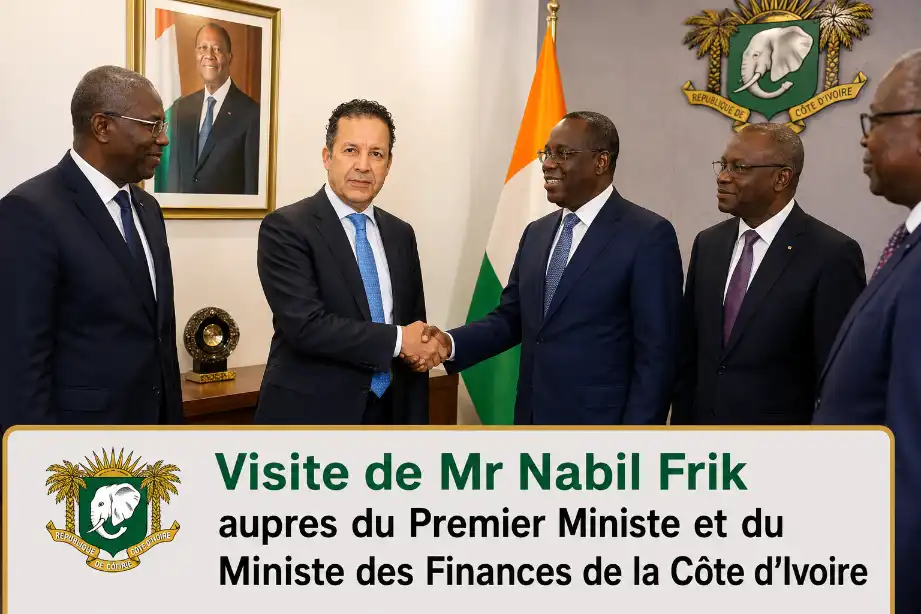
Strategic Vision: Beyond Simple Exportation
Nabil Frik’s contribution, as highlighted in the report, is based on a paradigm shift for the Ivorian economy:
- From Extraction to Added Value: Historically, BACB intervened primarily to finance the export of raw cocoa beans to global markets. Under Nabil Frik's leadership, the bank expanded its scope to finance industrialization.
- Supporting Local Transformation: The primary goal of this audience was to support Ivorian companies in acquiring industrial processing equipment. This enables Côte d’Ivoire to move beyond exporting raw commodities to exporting semi-finished products (cocoa butter, powder, liquor), thereby capturing a larger share of the global value chain.
Expertise in Trade Finance and Treasury
Nabil Frik’s intervention is highly technical. He provides Trade Finance solutions (Letters of Credit, Documentary Credits) and Treasury services that allow Ivorian businesses to:
- Secure international transactions with global partners.
- Access credit lines in hard currencies (USD, EUR, GBP), which are essential for importing industrial technology.
- Leverage BACB’s solid shareholding structure (notably the HSBC group), providing global credibility to Ivorian projects.
A Partner for National Development
By meeting with the Prime Minister, Nabil Frik positioned the bank as a partner in the National Development Plan (PND). His ability to engage at the highest levels of government demonstrates a deep understanding of macroeconomic stakes: it is not merely about lending money, but about aligning London's financing capabilities with Côte d’Ivoire's economic sovereignty priorities.
In summary, Nabil Frik embodies a new generation of financial leaders capable of mobilizing international capital to serve concrete development projects, thereby transforming the industrial landscape of West Africa.
Nabil Frik Visit to the Prime Minister of Ivory Coast: The Economic Context
A visit to a head of government by a senior banker is best understood against the economic background of the country concerned. Côte d'Ivoire is widely known as a major producer of cocoa, and the question of how much value stays in the country, rather than being created abroad, is a long-standing theme of public debate. The existing report on the Nabil Frik visit to the Prime Minister of Ivory Coast places the discussion within this setting: financing for equipment that allows raw commodities to be processed locally.
The following sections describe the general environment in which such discussions take place. They explain why banks and public authorities speak to each other and do not add any detail about the content of the meeting itself.
Nabil Frik Visit to the Prime Minister of Ivory Coast: Why Bankers and Governments Talk
Trade finance depends on trust in a country's payment system, its legal framework and its capacity to honour commitments. Governments shape that environment through economic policy, foreign-exchange rules and development plans. Banks, for their part, decide where to allocate credit lines and how to support exporters and importers. Dialogue between the two helps each side understand the other's priorities and constraints.
For an international bank, a meeting at the level of a Prime Minister signals interest in a market and an intention to work within its national development priorities. For the authorities, it is an opportunity to learn which financing instruments are available to local companies and under which conditions.
Letters of Credit, Confirmation and Guarantees in Commodity-Producing Economies
In economies that export agricultural commodities, trade finance instruments play a daily role. A letter of credit gives the exporter a payment undertaking from a bank, and where the issuing bank's country or institution is considered risky, a second bank may add its confirmation. Guarantees support performance and advance-payment obligations, particularly when equipment is purchased from foreign suppliers.
When a country wants to move from exporting raw products to exporting processed goods, these instruments take on a new dimension. Industrial machinery is often imported from abroad, usually in a hard currency, and suppliers typically want strong payment security. Documentary credits and guarantees can bridge the gap between the supplier's need for certainty and the local company's need for time to generate revenue from the new production line.
From Raw Commodities to Processing: What Banks Look At
When a bank is asked to finance processing equipment, its analysis goes beyond the equipment itself. Credit officers typically examine the following points:
- The reliability of supply of raw materials to the processing plant.
- The market for the finished or semi-finished products and the buyers' creditworthiness.
- The ability of the borrower to manage energy, logistics and maintenance requirements.
- The currency of revenues compared with the currency of the financing.
- The legal and regulatory framework for the investment.
These questions explain why discussions between banks and public authorities can be useful. Policies on infrastructure, energy supply and investment conditions directly affect whether a processing project is bankable.
Professional Background Relevant to the Nabil Frik Visit
Nabil Frik has more than 25 years of experience in international banking. He served as Managing Director and Head of Financial Institutions for Africa, the Middle East and Asia at British Arab Commercial Bank (BACB) in London from May 2013 to October 2025, with a portfolio of financial institutions above USD 1 billion across more than 30 markets. He holds British and German nationality and an MBA from Bielefeld University.
This background is connected with the subjects of the visit described above: relationships with banks and institutions across several markets, trade finance for importers and exporters, and the role of a London-based bank in financing international trade with Africa.
What the Nabil Frik Visit Illustrates About Trade Finance and Development
Beyond the individual meeting, the visit illustrates a broader principle. Sustainable development finance combines public policy with commercial banking capability. Governments set priorities, such as industrialisation and local transformation of commodities, while banks provide the instruments that let companies buy equipment, trade internationally and manage currency and payment risk.
For businesses in Côte d'Ivoire and neighbouring markets, the practical lesson is to prepare solid documentation, understand the available instruments such as letters of credit, confirmation and guarantees, and build lasting relationships with banks that know the market. For banks, it is to combine technical expertise with a real understanding of the country's economic strategy. The Nabil Frik visit to the Prime Minister of Ivory Coast is a good example of why that combination matters.
Nabil Frik on the web
- Global Trade Review (GTR) — GTR report on two BACB appointments in Côte d'Ivoire who report to Nabil Frik, the bank's Managing Director for Africa and the Middle East.
Related pages
- Africa trade finance guide
- UCP 600 text and rules
- Africa finance expertise consulting
- Afrique finance expertise conseil
- Afrika Finanzierung Beratung
- Africa Middle East banking expert
- Expert banque spécialiste finance Afrique
- Afrika Nahen Osten Bank Experte Finanzierung
- Lecturer professor in trade finance finance
- Professeur en trade finance (financement du commerce)
- Dozent Professor Trade Finance (Aussenhandelfinanzierung
- Nabil Frik AI and trade finance in Africa interview
- Nabil Frik trade finance Algeria interview
- LC fee and charge
- Asia and Middle East LC confirmation fees and charges
- South America LC confirmation fees and charges
- Internationaler Experte in Politik und Finanzen für Afrika und Naher Osten
- International expert for politics and finance for Africa and the Middle East Nabil Frik
- Expert international en politique finance et économie pour l’Afrique et le Moyen Orient
- LC discounting
- documentary collection